
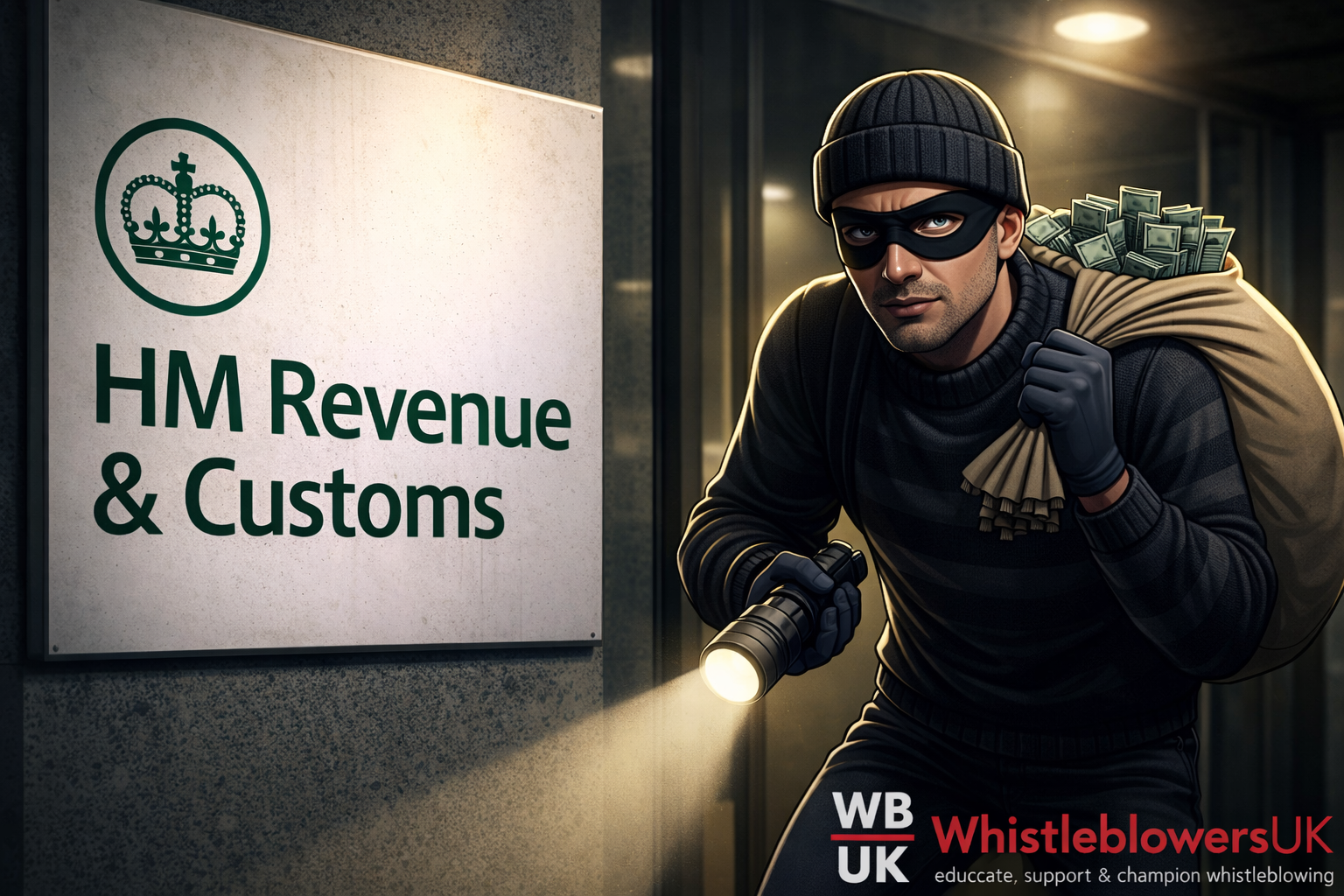
For many years the UK has been losing out on £billions in lost revenue or fraud. Our loss is a gain to the US and other jurisdictions that offer lucrative whistleblower incentive programmes. Not only do they offer rewards but more importantly they offer protection and anonymity and these programmes are open to everyone regardless of where they are domiciled. What’s more they work. A number of British whistleblowers supported by WhistleblowersUK have benefited from these programmes, but the UK hasn’t. Until recently these international programmes were the only show in town, but things are changing.
On Nov. 26, 2025, His Majesty’s Inspector of Taxes (HMRC) announced changes to its existing informant incentive programme. The relaunch of its programme goes some way toward moving the dial for whistleblowing but only time will tell if it has muddied an already complex landscape? While attitudes toward whistleblowers and whistleblowing have improved opinions about rewards in the UK remain divided. The revised HMRC incentive scheme is NOT a whistleblowing scheme but an informant scheme. Some will argue that this doesn’t matter but they are not in the shoes of the whistleblowers who are running the gauntlet of the employment tribunal.
Successive UK governments have stood by while criminals have siphoned off hundreds of £billions (currently estimated to be £5-6b per year) in tax fraud alone. This is depriving the country of much needed hospitals, schools and even ships, while failing to listen to or act on whistleblower information. Furthermore, these same Governments have allowed the UK Whistleblowing Framework to not only creak but fall apart. Leaving UK whistleblowers to pay the increasingly high price (including legal fees) of doing the right thing. Given the human and financial cost it’s time to look at new ways to bring down the costs and barriers to doing the right thing. If incentives help to recover tax revenue they could be used to expose other fraud and wrongdoing including preventing health, banking and tech scandals.
What whistleblowers want is a system that protects and supports people (whistleblowers) who come forward and aggressively follows and recovers the money – incarcerating criminals in the process.
Evidence for a systemic approach to crime prevention that includes whistleblowing.
The UK as the 5th largest economy has a big part to play in global anticorruption. Researchers including the Royal United Services (RUSI) think tank (RUSI) have supported incentives as a means of tackling the flow of illicit finance moving through the UK financial systems, referred to by some as the London Laundromat. Research estimates approximately 40% of the world’s dirty money uses the UK.
These figures make startling headlines so it was no surprise that the backbone of the proposals championed to combat serious organised crime came from the outgoing leader of the Serious Fraud Office Nicholas Ephgrave QPM. He calls for more whistleblowers and support for an Office of the Whistleblower. It’s time for the government to heed calls from those on the front line and use the opportunity to reform the UK whistleblowing framework. It needs to transform and modernise if it is going to play a key role in stopping and preventing the crime networks that exploit our weak and fragile regulatory system and mend the UK’s reputation.
In the meantime HMRC have persuaded the government that its incentive scheme can deliver, subject to a serious cash injection, a further £1billion+ to the taxpayer. We all need this gamble to pay off, failure, as they say, is not an option! If this scheme is a success then we will expect the government to be ready for the next step, an Office of the Whistleblower bringing with it protection for those who cannot afford the cost of speaking up and do not receive the protection currently available to informants.
Judging from conversations with US law firms, who report that they are “ready to file”, and feedback from our colleagues at the National Whistleblower Centre in Washington, HMRC should be optimistically cautious about the future of whistleblowing, or rather informing….
It is important to note that the HMRC scheme is not a new programme but an upgraded programme where “rewards” remain discretionary. This could be the fly in the ointment because it risks inconsistency, value laden decision making and failing to meet expectations by awarding lower rewards compared to those available in the US. Furthermore, it will be interesting to see how tightened up legislation to ban NDA’s impacts these cases, and deferred prosecution agreements as they play an important role on both sides of the pond at the moment.
What’s in a word?
WhistleblowersUK have supported thousands of people through the impact of doing the right thing. Their expectation was not a ‘reward’ but a quiet acknowledgement or thank you. The current whistleblowing framework turns raising a concern about fraud or money laundering into a dispute over compensation to be resolved by a judge in an Employment Tribunal, where over 95% of claims fail. Despite the injustice many whistleblowers remain firmly against the idea of rewarding whistleblowing. The common ground is that whistleblowers want nothing more than to get on with their lives and for their public spirited actions to be acted upon and, in cases where they experience retaliation to be restored to where they would have been if they had not spoken up.
WhistleblowersUK want to see whistleblowers recognised and support reform of the whistleblowing framework to include restitution. In some cases, e.g. a highly paid banker or doctor, restitution could be £millions as no one should be worse off for doing the right thing. We wholeheartedly support the HMRC reward scheme but we are against the conflation of the word whistleblower with informer.
Aligning whistleblowing with ‘informing’ will cause confusion. Language is important and the use of ‘informant’ interspersed with whistleblower might not only discredit whistleblowing but also disadvantage the whistleblower because of the complexities of the law. The language issue created plays into the old argument that whistleblowers are simply snitches, they are disloyal, (this could not be further from the truth). Failure to address the language issues is likely to push back at least some of the progress made so far to destigmatise and protect whistleblowers.
It stands to reason that some ‘informants’ under the HMRC scheme will also be whistleblowers and it is predicted by some whistleblowers that this will bring serious and unpleasant scrutiny of them by the Employment Tribunal.
Most people agree that it is impossible to compare the UK whistleblowing framework with the US and while lessons can and should be learned it is unfair to try to compare the two very different systems and the very different attitudes. At WhistleblowersUK we believe that the UK needs its own system taking the very best from the US and other global authorities. We need to define whistleblowing in law and learn the most important lessons, that successful whistleblowing programmes recognise that every citizen can be a whistleblower and that they all need to be able to access secure mechanisms through which to provide their information and to know that if their identity is discovered or they are subjected to retaliation that the State will protect them.
Overcoming fear is the way forward
Parliamentarians are not shy of using or understanding the terms whistleblower and whistleblowing it is a regular part of the Westminster vocabulary. Whistleblowing is at the heart of many speeches and has (too often) been the last line of accountability – bringing to light wrongdoing within the Parliamentary ranks when the guard rails have failed. Yet despite the protested support for the plight of whistleblowers and victims we are still debating the merits of reforming the whistleblowing framework and the resounding refusal from the treasury to use this term is not helping.
Hillsborough Law a flagship of the Labour manifesto has almost brought down the government because of its fear that speaking up will undermine national security. During the last government it was a similar story. Could it simply be that fear of blame is holding back even those in the highest offices? Governments have forgotten how important mistakes are to advancement in any field. Transformation requires a learn not blame culture that does not abandon accountability but reinforces it. This is at the heart of our proposals for an Office of the Whistleblower.
Why Do Incentives Matter?
Evidence from the US and other countries is compelling showing that rewards have proven to be one of the strongest tools in global anti-corruption enforcement because they:
- Encourage insiders with critical information to come forward, especially when the risks to their careers or safety are high.
- Shift incentives, make non-compliance and corruption unprofitable!
- Expand enforcement reach, whistleblowers become partners in assisting regulators to uncover misconduct that might otherwise go undetected.
According to U.S. government reporting, whistleblower reward programs have returned almost $1trillion to the public and facilitated major enforcement actions worldwide. For example, the SEC’s Office of the Whistleblower Report for the Fiscal Year 2024 noted that the Commission recovered $8.2 billion in financial remedies and $2.1 billion in civil penalties. 47 whistleblowers received a share of $255 million, bringing the gross value of awards to $2.2 billion since the program’s inception in 2011. But this is only part of the story. These figures strongly support the importance of whistleblowing to society, but what happens to the majority of whistleblowers who fail to meet the threshold.
In 2024 only 47 whistleblowers received a reward but the SEC received 24,000 tips from whistleblowers. It is easy to understand why British eyebrows – including UK businesses – might be raised when we learn that more than 14,000 of these tips were submitted by two individuals. This kind of headline gives credibility to those who suggest that reward programmes encourage internal sabotage or encourages ‘professional’ whistleblowers who prey on business. On the flip side businesses have the resources and obligation to do the hard yards when it comes to compliance so whistleblower reward programmes might be just the incentive required to tighten up they organisations and embrace whistleblowing saving huge sums of money and damage to reputation.
Can the pro’s outweigh the con’s and could rewards be an effective and fair aspect of the UK’s whistleblowing framework?
Proactive and dynamic whistleblower reward programmes must offer protection against retaliation, access to free legal support to assist the preparation and submission of claims, anonymous reporting, confidentiality and certainty regarding the award of rewards. In this we are united with law firms and whistleblower advocates globally and urge the UK Government to go further. Without guardrails for whistleblowers/informants, and checks and balances for organisations there is a risk of the HMRC programme undermining all of the progress that has been achieved over recent years.
A carefully articulated and properly executed whistleblower reward system could be a game changer for the UK and a step closer to the introduction of an Office of the Whistleblower. The improvements at HMRC should close the loop on the criminals who steal and defraud through the tax system. This is a watershed moment where at long last those responsible for wrongdoing, corruption, non-compliance, sanctions evasions and money laundering will be properly scrutinised and the public will be better protected.
What Comes Next
The launch of the UK’s whistleblower rewards program marks a meaningful cultural shift in a nation where whistleblowers have often been marginalized or punished. For NGOs, journalists, human rights defenders, and regulators, the program offers a new path to uncovering fraud, corruption, sanctions violations, money laundering, and tax evasion at home and abroad.
With about five months until the scheme takes effect, the core question is whether the UK and HMRC will strongly enforce the new law. Should the program prove effective, amendments in future budget reports – such as mandatory rewards and stronger confidentiality guidelines – could be added.
During Whistleblowing Awareness Month 2026 (this summer) we will be holding a series of events to celebrate the role of whistleblowers in the global anti-corruption strategy and look forward to hearing from leading international experts.
For Whistleblowers Seeking Support
If you are unsure about whether to speak up, what rights you have or the best way to take things forward, you are not alone – join us and meet others who have shared your concerns through our lively and supportive peer to peer support group session. You may be seeking specific legal information which is why we have a legal panel from all over the world, and a range of experts including our sector specific working groups. Before you make a decision come and speak to us. Contact details are on the website: www.wbuk.org
Support WhistleblowersUK
WBUK works tirelessly to champion whistleblowing through its programme of education and support. We receive no government funding and rely on donations the sponsor generosity to help us to help you. see our website wbuk.org or https://donate.stripe.com/9B67sL31TcTY0xj1KPfQI01
