
Join our panel to discuss a little understood problem in the UK by emailing secretary@wbuk.org
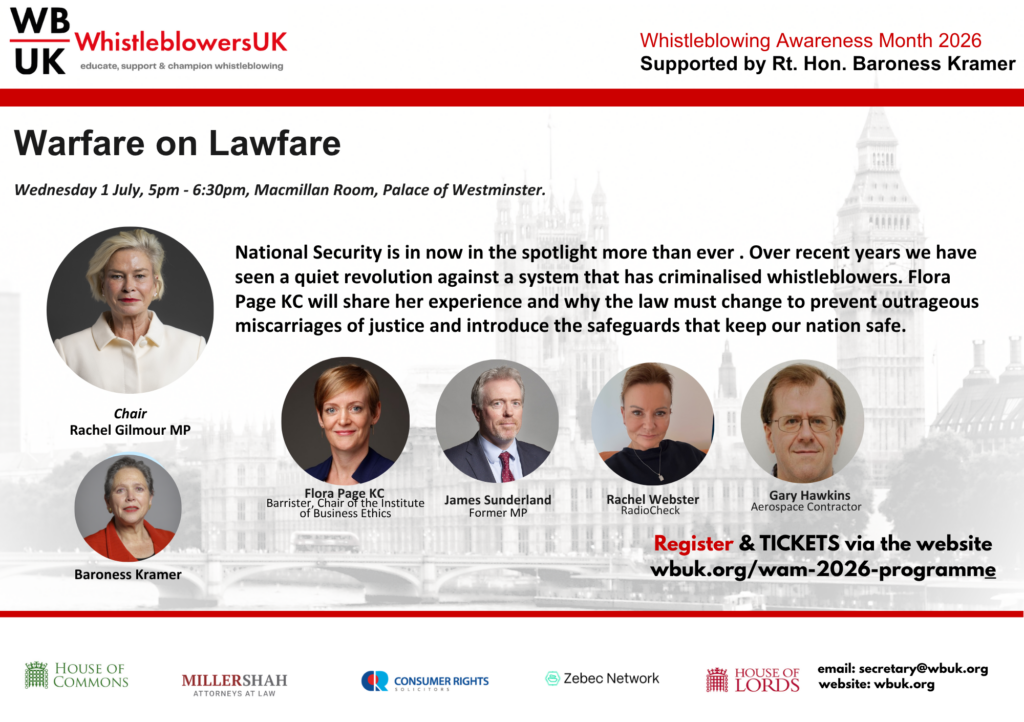
“Warfare on Lawfare is not about limiting access to justice. It is about preventing the abuse of legal processes to obstruct justice, silence whistleblowers, conceal wrongdoing and undermine Parliament’s ability to hold powerful institutions to account.” Rachel Gilmour MP
Warfare on Lawfare
Why Parliament Should Treat Strategic Litigation as a National Public Interest Issue
Key Message
Strategic litigation (“lawfare”) is increasingly recognised as a method used to suppress whistleblowers, journalists and campaigners before evidence of wrongdoing reaches the public. While only a small number of cases appear in court, Parliament, regulators and the Government have all acknowledged that the overwhelming majority of cases are never reported or recorded because legal threats succeed before proceedings begin.
The Scale of the Hidden Problem
The UK currently has no official register of Strategic Litigation Against Public Participation (SLAPPs) or lawfare cases.
As a result:
- No Government department records the number of whistleblowers silenced through legal threats.
- No regulator records the number of investigations abandoned because of lawfare.
- No court records how many cases settle following intimidation.
- There is therefore no official figure for the number of unreported cases.
However, Parliament has repeatedly concluded that the known cases represent only a small fraction of the true problem.
Government’s own Call for Evidence stated:
“There will be many cases which never reached court because the respondent was intimidated into settling.”
The House of Lords Communications and Digital Committee similarly concluded that known SLAPPs are “just the tip of the iceberg.”
Government evidence also noted:
- 14 identified UK SLAPP cases in 2021
- but accepted that this dramatically understates the real picture because most threats never become litigation.
Lawfare Against Whistleblowers
Whistleblowers are particularly vulnerable because:
- they rarely have institutional funding;
- employers possess vastly greater legal resources;
- threats of defamation, breach of confidence, injunctions and costs frequently prevent disclosures;
- many cases end through settlement agreements with confidentiality clauses before any public scrutiny.
Cross-party MPs have argued that anti-SLAPP legislation should specifically protect whistleblowers because existing law allows organisations to weaponise legal costs to suppress disclosures made in the public interest.
Former Military Personnel
There is no official database recording the number of lawfare or SLAPP actions brought against former military personnel.
The phrase “lawfare” has historically also been used in relation to legal claims concerning military operations overseas, creating confusion in official statistics.
Former members of the Armed Forces who have raised concerns over procurement, misconduct or operational failures have reported legal pressure, confidentiality restrictions and reputational attacks, but there is no published Government figure identifying how many have faced strategic litigation.
The absence of data itself demonstrates a regulatory gap.
The Post Office Horizon Scandal: Lawfare in Practice
The Horizon scandal provides one of the clearest examples of institutional lawfare.
What happened?
Between 1999 and 2015:
- more than 700 sub-postmasters were prosecuted by the Post Office;
- hundreds received criminal convictions;
- many were imprisoned;
- many lost homes, businesses and livelihoods.
The Court of Appeal later ruled that the prosecutions were an “affront to the conscience of the court” because of fundamental disclosure failures and abuse of process.
How lawfare operated
The Horizon Inquiry has shown that the Post Office:
- aggressively defended litigation;
- failed to disclose material evidence;
- resisted independent scrutiny;
- pursued private prosecutions;
- challenged campaigners seeking disclosure;
- attempted to deter criticism through sustained legal action.
MPs have cited the Post Office scandal as a leading example of why comprehensive anti-SLAPP legislation is required.
How Many Were Silenced?
No official figure exists.
However, publicly established facts include:
- more than 700 wrongful prosecutions;
- numerous individuals pleaded guilty under pressure despite maintaining innocence;
- many accepted financial settlements or contractual termination rather than challenge the Post Office;
- many never appealed for years because they believed the legal system could not defeat the Post Office.
The Inquiry continues to hear evidence from people whose experiences never reached court.
Why This Matters
Lawfare is not merely about expensive litigation.
It creates a chilling effect that:
- prevents regulators receiving evidence;
- discourages witnesses from coming forward;
- delays exposure of corruption and unsafe practices;
- increases public expenditure by allowing misconduct to continue unchecked.
By the time wrongdoing becomes public, the financial and human costs have often multiplied dramatically.
Recommendations
Parliament should consider:
- Establishing an independent Office of the Whistleblower with powers to investigate allegations of retaliatory lawfare.
- Introducing comprehensive anti-SLAPP legislation extending beyond economic crime.
- Requiring mandatory reporting of legal threats intended to suppress protected disclosures.
- Creating a national register of lawfare and SLAPP complaints.
- Providing cost protection and legal assistance for whistleblowers acting in the public interest.
- Empowering regulators to investigate organisations that repeatedly deploy legal tactics to suppress legitimate disclosures.
Conclusion
The greatest concern is not the relatively small number of reported SLAPPs, but the unknown number that never become visible. The Government, Parliament and regulators have all acknowledged that existing statistics capture only a fraction of the problem. Until lawfare is measured, monitored and deterred, whistleblowers will continue to be silenced before the public ever finds out!
“When the law is used to silence whistleblowers instead of exposing wrongdoing, justice is turned on its head. An Office of the Whistleblower would help ensure that the law protects those who speak up for the public interest, rather than those who seek to suppress it.” Baroness Kramer 2026
Come and join us tomorrow at 1700 when Flora Page KC will kick off the discussion reviewing her experience of representing sub post masters and whistleblowers in our legal system. For more information see WAM on our website wbuk.org or email secretary@WBUK.org

WhistleblowersUK Proposals for an Office of the Whistleblower Debated in the House of Lords