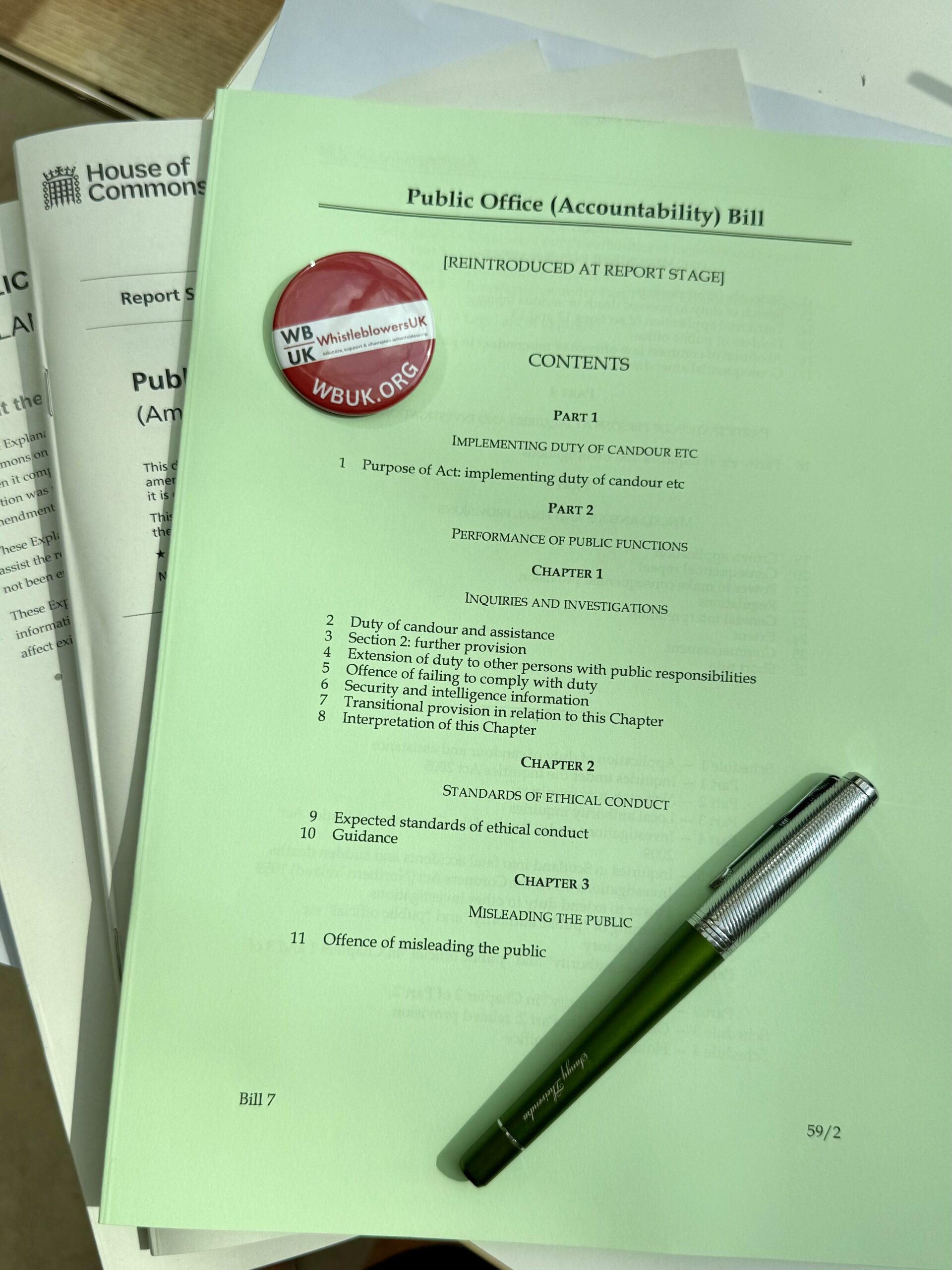
Could The Public Office Accountability Bill be the Champion?
There is an old saying that sunlight is the best disinfectant. Every major public scandal in recent history, from failures in healthcare and financial misconduct to environmental harm and public sector corruption has one thing in common. Someone knew. Someone spoke up. Too often, no one listened and the impact has been catestrophic as some senior political leaders can now attest!
Whistleblowers are among our most valuable public servants, whether they work in government, business, the NHS, policing or charities. They identify risks long before they become headlines. They save lives, protect public money and uphold the integrity of our institutions.
Yet in Britain we continue to misunderstand whistleblowing. We treat it as an employment dispute when it is fundamentally a matter of public protection.
As Parliament considers how best to reform whistleblowing legislation, there is increasing discussion about introducing financial rewards similar to those operating in parts of the United States. While these schemes have undoubtedly helped uncover significant financial fraud in certain regulated markets, particularly securities enforcement, they should not become the only model for the UK’s whistleblowing framework.
Britain needs champions for whistleblowers and it needs to accept that informants and bounty hunters exist and can be incredibly helpful to recovering fraud and exposing serious crime but distinction matters.
Reward schemes were developed in the United States to address a specific regulatory challenge: encouraging individuals with inside knowledge of complex financial fraud to come forward where enforcement agencies might otherwise struggle to detect wrongdoing. In programmes such as those operated by the U.S. Securities and Exchange Commission, rewards are typically paid only after successful enforcement action and are subject to strict statutory criteria including abuse of whistleblowers as seen in the recent case of BGC Whistleblower Simon Andriesz.
Those programmes have recovered billions of dollars for the American, Canadian and other international taxpayers and have demonstrated that carefully designed incentives can improve detection of complex financial crime. There can be no denying how effective they can be after reports that in the US these schemes have recovered $1 trillion.
However, these schemes were never intended to be a universal model for every form of whistleblowing.
In the UK the challenges faced by a nurse raising concerns about patient safety, a police officer exposing misconduct, an engineer reporting dangerous infrastructure, or a care worker highlighting abuse are fundamentally different from those faced by an investment banker reporting securities fraud.
The evidence supports our assertion that the overwhelming majority of whistleblowers do not speak up because they hope to receive a financial reward. The majority of people who speak up do so because it is their job or to protect others from harm. A reward is the last thing on their mind.
People speak up because they believe something is wrong and as the law stands a reasonable belief is all that is required.
Many people speak up anticipitating they may lose their income, but few imagine that it will end their career, damage their health and sometimes family relationships.
Motivation to do the right and moral things is at the heart of whistleblowing.
That point is critically important.
A legislative framework built primarily around financial incentives risks changing public perceptions of whistleblowing itself. Instead of recognising whistleblowers as individuals acting in the public interest, critics may characterise them as people motivated by personal gain. That perception is unfair and could be used to undermine public confidence in the very people we most need to protect us all.
There is another important consideration.
Every whistleblowing system, whether in Britain, America or elsewhere must have safeguards against malicious or knowingly false allegations. Most people who raise concerns do so honestly and in good faith, even where they may ultimately be mistaken. The law should continue to encourage such reporting but needs to address cases where whistleblowers are proven to have manufactured complaint or make knowingly false, malicious or vexatious claims. It is fair to say that very few such cases exist not least because the process is complex and can last years but unfortunately we have seen cases where unscrupulous people use ‘whistleblowing’ as an opportunity to try to extort money from organisations. The law needs to be used as severely on these people as those who cause harm to genuine whistleblowers.
The UK can learn from other jurasdictions whose experience demonstrates that organisations require fair procedures to distinguish genuine disclosures from allegations that are deliberately fabricated or made for an improper purpose. A system perceived to reward allegations without rigorous independent assessment could create unnecessary disputes, increase investigative costs and damage confidence among both employers and employees.
This is not an argument against reform.
Quite the opposite.
Britain desperately needs reform.
But it needs reform built around independence, trust, accountability and fairness.
An independent Office of the Whistleblower would transform the current fragmented landscape. Instead of forcing individuals into lengthy Employment Tribunal proceedings that focus primarily on their treatment after speaking up, an independent Office could assess disclosures on their merits, coordinate regulators, identify systemic risks, ensure investigations are conducted properly and provide practical support to those acting in the public interest.
Such a body would benefit everyone
- Whistleblowers would gain an independent champion.
- Employers would receive consistent guidance and clearer processes.
- Regulators would benefit from better intelligence and coordination.
- The public would gain greater confidence that serious concerns are addressed before they become national scandals.
Importantly, an independent Office would also help filter concerns at an early stage. It could distinguish between disclosures that require regulatory investigation, workplace grievances that should be resolved internally and allegations that lack sufficient evidence. This would protect both whistleblowers and those who are the subject of allegations by ensuring fair, consistent and proportionate assessment.
Good whistleblowing legislation will encourage earlier, safer and more effective disclosure of genuine public interest concerns.
That is why whistleblowers need champions.
They need independent advice before they speak up.
They need protection while concerns are investigated.
They need fair treatment afterwards.
And society needs institutions capable of distinguishing truth from rumour, evidence from speculation and public interest from personal grievance.

Britain has Reached a Crossroads
The proposed Hillsborough Law rightly seeks to embed candour after tragedy. The logical next step is to ensure that those who identify risks before tragedy are equally protected.
If we get this right, we can move from a culture that reacts to disaster to one that prevents it.
The question facing Parliament is therefore not whether whistleblowers deserve better protection, they unquestionably do. The question is whether we build a system that values integrity over incentives, independence over fragmentation and prevention over costly public inquiries.
The answer should be clear.
Whistleblowers do not need bounty hunters but they need real and accessable legislation that protects them from the outset.
Whistleblowers need a champion.