
Session 9 of #WAM2026 – Sponsored by Tessa Munt MP vice chair WhistleblowersUK
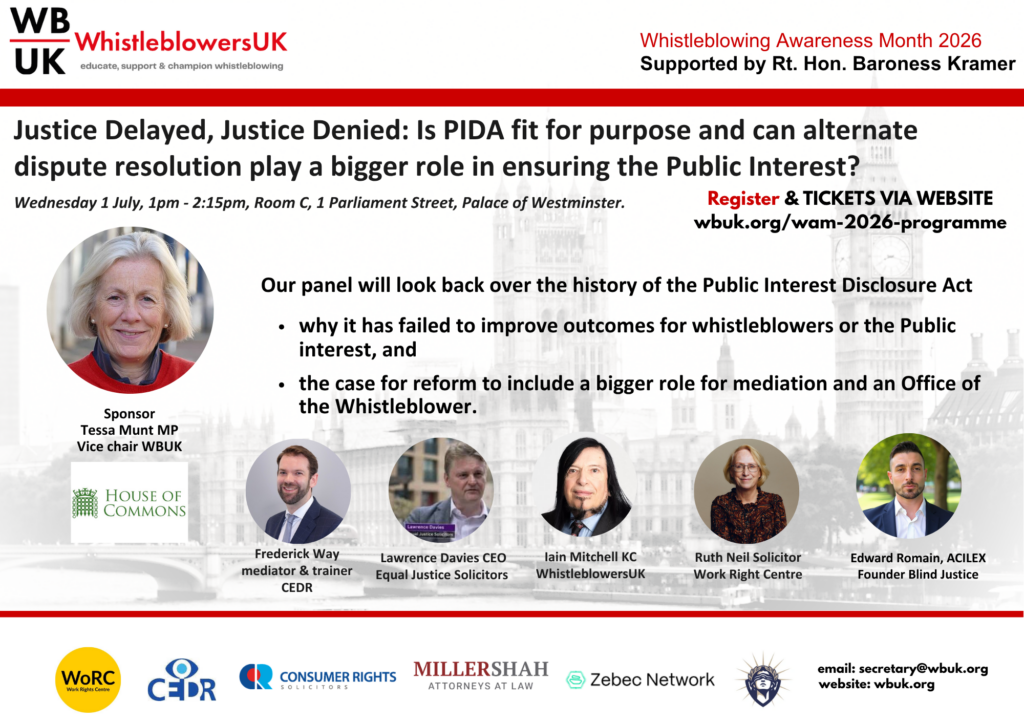
“Justice Delayed, Justice Denied”.
Date – 1st July 2026 / Room C, 1 Parliament St, Westminster / Time: 1300-1415
Sponsor – Tessa Munt MP, vice chair WhistleblowersUK
This session forms part of the programme celebrating and recognising the role of whistleblowing in tackling crime, corruption and cover ups. The panel will consider the merits of ADR in the context of putting an end to delays that have reduced confidence in the UK’s justice system and the role of an Office of the Whistleblower in making access to justice available to every citizen.
Note to speakers and guests – please allow time for airport style security and bring proof of invitation and additional ID (e.g. passport or drivers licence). Reporting and photos are permitted only with permission of the subject OTHERWISE this event is held under Chatham House Rules (you can report but not attribute comments to the speakers).
The event will start and end promptly as the rooms are usually booked back to back.
Background Information
WhistleblowersUK is a not for profit organisation working to support whistleblowers and provide educational and information for the public. We have developed and continue to lead the campaign for an Office of the Whistleblower. The Government Whistleblowing Framework Review and forthcoming Public consultation resulted from the work of WBUK who continue to work closely with the Department for Business and Trade and other government departments to shape the future of legislation.
Currently Whistleblowers and Employers are waiting for between 2 and 4 years to get to a full hearing with some cases now running in excess of 10 years. The cost to the public purse if unsustainable and the cost to the public interest is counted in headlines in the press; The Post Office Scandal, Maternity Scandal, Covid/PPE Scandal, Grenfell Tower, Contaminated Blood, the list goes on.
The original intention of PIDA was to level the playing field in employment disputes and make access to justice fair and equal to all parties by envisioning that each side would be able to self-represent. Today it is mostly accepted that PIDA has not fulfilled its ambitions as borne out by the poor success rate, escalating costs and lengthy delays.
The evidence indicates that improving outcomes will require stronger coordination, consistent standards, better support for whistleblowers, and clearer oversight across regulators and employers. These are precisely the governance gaps that an independent Office of the Whistleblower is intended to fill. While the report remains neutral on whether such an Office should be established, its findings provide a substantial evidence base that supporters of the proposal can cite in arguing that the current fragmented framework requires a single independent body with system-wide oversight.
The crisis engulfing the Employment Tribunal
In July 2023 the President of the Employment Tribunal (ET), Barry Clarke, issued Guidance addressing Alternative Dispute Resolution (ADR). He explained that a new form of ADR was being introduced called the Dispute Resolution Appointment or DRA “…a non-consensual, confidential and evaluative process”. He explained:
“The need for such appointments arises because of the high number of discrimination and whistleblowing detriment that populate the outstanding stock of cases to be heard by the Employment Tribunals, where many parties do not wish to engage in either judicial mediation or judicial assessment. Their reluctance to do so may be because one of the parties is not professionally represented. Because of the legal and factual complexity of such cases, and most especially the large number of issues identified for judicial determination, they may require multiple case management hearings and time-consuming correspondence with the tribunal. They also require longer hearings (into a second week or longer), and so they contribute significantly to extended waiting times in England and Wales.”
The President’s Guidance is here.
Despite attempts to end the delays none of the 3 ADR measures deployed by the ET to date have stemmed the tide of ever-increasing Open Cases.
In the 3 years since the introduction of the Guidance there has been no reduction in the number of Open Cases, on the contrary the number of Open Cases has almost doubled every year since 2024. The monthly Management Information published by His Majesty’s Courts and Tribunals Service shows things are becoming grimmer:
| Month/Year | No of Open Cases in the ET |
| April 2024 | 43,951 |
| April 2025 | 52,965 |
| April 2026 (latest available) | 74,320 |
The management information (MI) for April 2026 are here. There appears an anomaly between the figure for April 2025 published at that time and the figure shown in the latest MI. This may be the result of moving from a legacy computer system, see footnote 5 on the Excel reached via the link.
Assuming nothing is done then a further doubling of the Open Caseload raising the number to 117,030 is anticipated by April 2027.
Speaking in the House of Lords on 16 December 2025, whilst answering questions about the Employment Rights Bill, Baroness Lloyd of Effra (then Parliamentary Under-Secretary of State in the Department for Business and Trade) said,
“I remind noble Lords of our commitment to convene meetings with shareholders so that those from the City, law practitioners and others can feed into that. Those findings will be taken into account by the dispute resolution task force that we are setting up—it will have all that information to hand. We are obviously very keen to improve the functioning of the dispute resolution system.” col 672:
To date there is no evidence of the taskforce.
The crisis arising from the proliferation of whistleblowing cases does not begin at the ET. ACAS reports that whistleblowing cases are driving the backlog afflicting its service too:
“Demand for early conciliation has risen in 2024–25 and we received the highest number of early conciliation notifications since 2019–20. This resulted in 20,000 more notifications in 2024–25 compared to the previous year, a 19% increase. A driver for this was an increase in open-track notifications, which are cases that relate to discrimination or whistleblowing, and we received a 29% increase in such claims compared to 2023–24.”
ACAS Annual Report 2024-2025 (latest available) at page 33, here.
A potential solution to this crisis could be to outsource all cases that include a claim for whistleblowing to private mediation as a pre-condition to proceedings in the ET. Türkiye introduced this for Labour disputes in January 2018. The scheme has been successful and recently extended to other types of claim.
Recent research funded by the Employment Lawyers Association argued for, “Reimagining Employment Dispute Resolution and Enforcement”. Its research was published in June 2026 and is available from Hart Publishing here. Key findings:
Recommendation 5:
“Parties should be required to attend either a phone conciliation appointment or online mediation appointment according to the complexity of the matter. These sessions should be resolution-focused, rather than problem-focused, and should include an element of ‘reality testing’, rather than being purely facilitative. The specific type of mediation should be tailored to the circumstances of the case. Where required, such as in certain discrimination matters, the mediation should follow a ‘trauma informed’ approach or transformative mediation approach.”, p.321
Recommendation 6:
“Where conciliation or mediation is unsuccessful in resolving the dispute, the Employment Resolution Service should certify that the parties have attended to permit them to bring or defend a claim in the tribunal.”, p.322
It is clear that conciliation can be cost effective but can it be extended and embedded into wider changes including an Office of the Whistleblower?
Facts at a Glance
Annual cost to the taxpayer – £77.7 million excluding buildings and IT infrastructure.
ACAS report that 6% of claims include whistleblowing which significantly increases the time required to dispose of hearings.
Why this matters for an Office of the Whistleblower
These figures reinforce one of the central arguments for establishing an independent Office of the Whistleblower. At present:
- there is no national dataset identifying whistleblowing cases;
- there is no body responsible for monitoring whistleblowing outcomes across the tribunal system;
- tribunal litigation is expensive, slow and reactive, costing taxpayers at least £77.7 million a year before wider HMCTS overheads; and
- delays caused by judicial capacity mean that many whistleblowers wait years for resolution.
An Office of the Whistleblower with powers to receive disclosures, oversee investigations and resolve concerns before employment relationships break down could reduce reliance on costly tribunal litigation while improving public protection and accountability.
Speakers
Frederick Way, CEDR Mediator & Trainer – is a leading UK Mediator working across Civil, Commercial and Employment disputes. As a member of the CEDR UK’s Commercial Mediator Panel Frederick has resolved hundreds of cases for individuals, teams andorganisations in the UK and internationally. Frederick is ranked by Legal 500 2026 as a Leading Mediator for the UK. In December 2024, Frederick was named Civil/Commercial Mediator of the Year.
Ruth Neil, Employment Law Solicitor at Work Rights Centre. Ruthhas over 20 years of experience working in employment law in private practice acting for employers as well as employees. Her work at the Work Rights Centre includes representing migrant and disadvantaged workers including those who have made protected disclosures. Ruth believes that everyone should have equal and equitable access to legal representation and strives for outcomes that will improve the lives of her clients.
Iain Mitchell KC, Chair WhistleblowersUK Legal Panel Chair of the Legal Panel of WhistleblowersUK and Honorary KC of OpenUK. Iain’s legal career began when he was called to the Scottish Bar in 1976 English Bar in 2012. He is accredited as a mediator by the Mediation Bureau (Scotland) and by Mediation Forum Ireland. He is a member of the Scottish Council for International Arbitration and sat on the bench as a Temporary Sheriff from 1992 to 1997. Iain is an experienced litigator with a wide and varied civil practice, with strengths in Business and Banking law, European Law, Public Procurement Law, Employment Law and Public Law.
Lawrence Davies, CEO, Equal Justice Solicitors, Legal Officer at SUTR, Board Director Kingston REC, Board member SME4Labour, Equalities Officer UNITE. Lawrence has a long career representing claimants in the employment tribunal in whistleblowing and discrimination cases. Notably he represented in the Baby P whistle-blower claim which led to a Government independent inquiry. Lawrence works across the public and private sectors offering pro-bono support to WhistleblowersUK. Over the years he successfully negotiated and secured exceptional settlements.
Edward Romain ACILEX is founder & CEO of Blind Justice UK, a charity for unrepresented citizens and litigants in person. Its audit of court administration found 92% of court documents missing and 85% of mandatory submissions never reaching the decision-maker. Edward is the author of ‘A Litigant in Person’s Guide to Surviving the Justice System’ and has developed and built AEGIS, an AI tool to help unrepresented litigants prepare their cases.
Iain Mitchell KC Chair WhistleblowersUK Legal Panel,
“Following extensive consultation with the UK Government as part of the Whistleblowing Framework Reviewthere are indicationsthat our proposals for an Office of the Whistleblower are under serious consideration. An Office of the Whistleblower will rectify the issues with the existing framework, which is not failing because of one defective law, but because it operates as an uncoordinated system with no central leadership or accountability. Our proposals offer sweeping and comprehensive change that will address injustice and prevent harm, scandals and waste.”
Georgina Halford-Hall, CEO WhistleblowersUK,
“In far too many cases whistleblowing proves catastrophic to both the whistleblower and society we will continue to work closely with Government and press for an Office of the Whistleblower.”
For Further Information or assistance please contact Georgina Halford-Hall ceo@wbuk.org or Iain Mitchell KC igmitchell@wbuk.org

WhistleblowersUK Proposals for an Office of the Whistleblower Debated in the House of Lords