
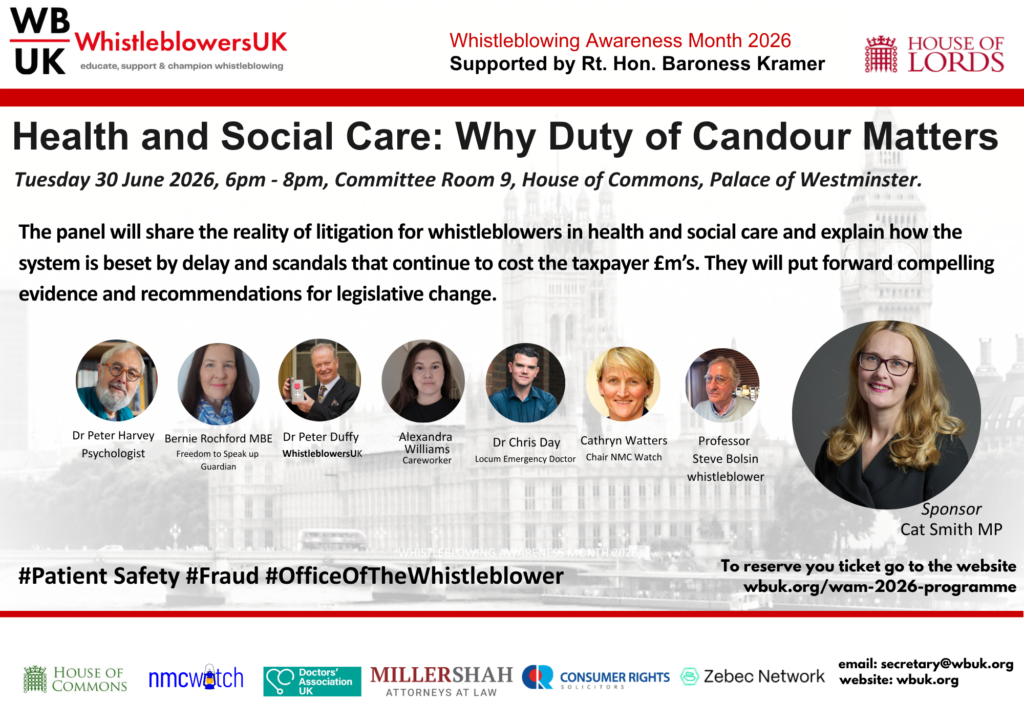
Westminster Committee room 9 -30th June 2026 1800-2000 – If you would like to attend email peterduffy@wbuk.org before 1300 today.
Today is event number 7 of #WAM2026 with thanks to Cat Smith MP, Rachel Gilmour MP, Tessa Munt MP, John Glen MP, Seamus Logan MP, Anna Dixon MP who have all supported constituents who will be attending this meeting.
Whistleblowing Awareness Month 2026 (#WAM2026) Session 7
“Why Duty of Candour Matters”
House of Commons – Westminster, Committee Room 9
Date 30 June | Time 6.00–8.00 pm
Background
The National Health Service is one of the largest publicly funded healthcare systems in the world. Across the United Kingdom, health expenditure exceeds £300 billion annually, while adult social care accounts for a further £35 – 40 billion of public and private expenditure each year. Together, the NHS and social care employ more than 3.5 million people, including approximately 1.7 million NHS employees and 1.6 million people working in adult social care.
These services care for millions of people every day and are built upon public trust. They rely upon staff being able to identify risks, challenge poor practice and raise concerns before patients are harmed. Effective whistleblowing is therefore not simply an employment issue it is fundamental to patient safety, public confidence and the stewardship of billions of pounds of public money.
Where organisations fail to listen the consequences are measured not only in avoidable deaths and injuries but also in enormous financial costs arising from litigation, public inquiries, regulatory intervention, compensation, recruitment, staff turnover and loss of public confidence.
The importance of Duty of Candour
This Westminster briefing brings together parliamentarians, journalists and frontline voices to examine the relationship between whistleblowing, the Duty of Candour and organisational accountability.
The event opens with a recorded address from Professor Steve Bolsin, whose disclosure of failures in paediatric cardiac surgery at Bristol Royal Infirmary remains one of the defining whistleblowing cases in NHS history. His experience illustrates both the courage required to speak up and the profound personal consequences suffered by many whistleblowers despite acting in the public interest.
His contribution sets the context for an evening focused on transparency, accountability and learning.
Learning from lived experience
The programme will include presentations from NHS and social care whistleblowers whose experiences demonstrate that, despite repeated reviews and policy commitments over the past three decades, significant cultural barriers remain.
Their testimonies highlight:
- fear of retaliation;
- career detriment and dismissal;
- ineffective internal reporting systems;
- inadequate legal protection;
- organisational defensiveness; and
- failures to investigate concerns independently;
- the financial burden on the taxpay
These experiences demonstrate the continuing gap between statutory protections and operational reality.
The financial cost of failing to listen
Whistleblowing is often viewed as an organisational risk. The greatest financial risk arises when whistleblowers are ignored.
Major public inquiries including Bristol, Mid Staffordshire, Morecambe Bay, Shrewsbury and Telford, East Kent, Nottingham maternity services and the Infected Blood Inquiry have demonstrated a common theme: staff repeatedly raised concerns which were dismissed, minimised or suppressed.
The financial consequences have been extraordinary.
The Infected Blood Inquiry alone has resulted in compensation commitments expected to exceed £11 billion. Maternity failures across multiple NHS Trusts have generated hundreds of millions of pounds in clinical negligence liabilities, in addition to the costs of independent reviews, investigations, regulatory intervention and long-term care for injured children. Instead of a dedicated budget to prevent scandals, the NHS faces an estimated £27.4 billion bill in negligence claims for maternity failures since 2019. This figure significantly exceeds the entire estimated £18 billion budget allocated to maternity care over the same period. [1]
These costs sit alongside the immeasurable human consequences for patients, families and healthcare professionals. Earlier intervention through effective whistleblowing could have prevented many of these harms.
The cost of employment litigation
When whistleblowers are dismissed or subjected to detriment, many have little option but to pursue claims of automatic unfair dismissal in the Employment Tribunal.
Whistleblowing litigation is among the most complex forms of employment litigation.
A typical NHS whistleblower may incur legal costs ranging from £50,000 to well in excess of £250,000 with many cases requiring years of preparation, multiple hearings and appeals. Employers frequently incur comparable or greater expenditure once legal representation, HR resources, management time, expert witnesses and external investigations are included.
For NHS organisations these costs are ultimately borne by the taxpayer.
The wider costs are equally significant:
- years of lost clinical expertise;
- sickness absence and mental ill-health;
- recruitment and agency staffing costs;
- prolonged regulatory investigations;
- reduced staff confidence in speaking up; and
- diminished public trust.
Employment Tribunal delays further compound these problems. Automatic unfair dismissal and whistleblowing claims routinely take several years to reach a final hearing, prolonging uncertainty for whistleblowers while increasing legal costs for employers and delaying organisational learning. Justice delayed is patient safety delayed.
Why an Office of the Whistleblower is needed
The proposed Office of the Whistleblower offers an opportunity to transform this landscape.
Rather than relying almost exclusively on employment litigation after damage has occurred, an independent Office could:
- investigate disclosures at an early stage;
- require organisations to address risks before harm escalates;
- protect whistleblowers from retaliation;
- oversee compliance with the Duty of Candour;
- identify systemic failures across regulators and public bodies;
- reduce the need for lengthy Employment Tribunal litigation; and
- deliver substantial savings to the public purse.
By resolving concerns earlier and independently, the Office could avoid many of the costs currently associated with prolonged litigation, repeated public inquiries and avoidable clinical negligence releasing funding to advance clinical excellence.
Legislative reform
This event includes a legal briefing on the proposed Office of the Whistleblower Bill and the wider programme of whistleblowing reform.
Discussion will consider how legislation can:
- strengthen legal protection for whistleblowers;
- provide independent investigation of disclosures;
- improve organisational accountability;
- support implementation of the Duty of Candour;
- improve patient safety; and
- reduce unnecessary expenditure across the NHS and social care;
- transform culture, learning and accountability
A critical moment for reform
Recent developments provide a compelling context for this discussion.
The Ockenden Review into maternity services reinforced longstanding concerns about failures to listen to families and frontline staff, inadequate escalation of risks and cultures resistant to transparency.
The ongoing Nottingham maternity investigation has now identified around 2,500 families whose care is being examined, making it the largest maternity investigation in NHS history. Similar themes have emerged from Morecambe Bay, East Kent, Shrewsbury and Telford and other maternity services across England.
The publication of the Amos Review into NHS maternity leadership and culture further reinforces concerns regarding leadership, accountability and the treatment of staff who raise concerns.
Alongside the findings of the Infected Blood Inquiry, these reports demonstrate that failures of candour are not isolated events but recurring systemic failures.
Each inquiry has repeated many of the same recommendations. Yet implementation has remained slow.
The continued absence of an independent Office of the Whistleblower means that opportunities to identify risks early, protect those who speak up and prevent avoidable harm continue to be missed.
Looking ahead
The meeting will conclude with discussion involving parliamentarians, journalists and invited guests.
The central question is no longer whether whistleblowing legislation requires reform. Rather, it is whether the United Kingdom can continue to afford the human and financial costs of maintaining the current system.
A healthcare system that fails to listen cannot learn. One that cannot learn cannot improve.
Duty of Candour, effective whistleblowing and an independent Office of the Whistleblower are therefore not simply matters of employment law—they are essential pillars of patient safety, public accountability and the effective stewardship of public resources.
“Ultimately, a healthcare system that fails to listen cannot learn, and one that cannot learn cannot improve. Duty of Candour and effective whistleblowing are therefore not optional safeguards; they are foundational to patient safety, public confidence, and the integrity of care.”
Dr Peter Duffy, co-chair WBUK Health and Social Care Group.
For further information or enquiries please contact Georgina Halford-Hall ceo@wbuk.org or Dr Peter Duffy peterduffy@wbuk.org
[1] https://publications.parliament.uk/pa/cm5901/cmselect/cmhealth/895/report.html#heading-5

WhistleblowersUK Proposals for an Office of the Whistleblower Debated in the House of Lords