
18/06/26: Managing Risks and Rewards, How Incentives Can Change the Whistleblowing Landscape
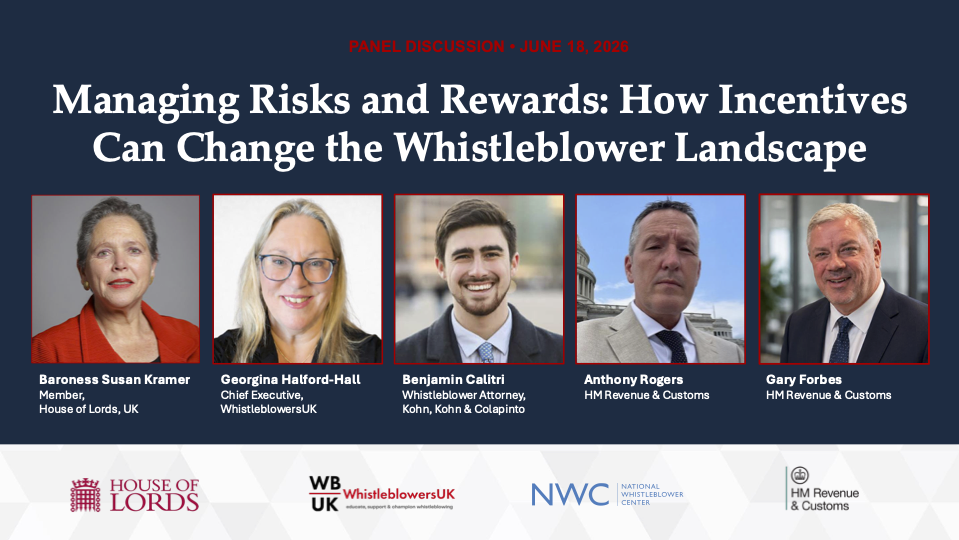
Yesterday we held our panel discussion event in the beautiful, old, Palace of Westminster, ‘Managing Risks and Rewards: How Incentives Can Change the Whistleblower Landscape’, with a wonderful line up of speakers.
Baroness Kramer opened the evening with an address where she spoke on the importance of whistleblowers, highlighting the holes in the current UK system to protect whistleblowers who seek to do public good. Baroness Kramer outlined that whistleblowers should not be punished or subject to mistreatment or retaliation for acting in the public interest.
Benjamin Calitri from US law firm Kohn Kohn & Colapinto, provided an insight into the US whistleblower rewards system and its impact on the whistleblowing landscape. Ben explained his strong support of rewards and championed the US system for rewarding whistleblowers of white collar crimes. He explained how
“crime occurs most often when it can be explained as a rational activity and that when whistleblowing increases, the risks for committing crime decrease, thus making crime it a less rational activity.”
Ben concluded by saying that to make crime a less rational activity, we need to make whistleblowing a rational activity and he argued that this can be done through providing incentives, as successfully achieved in the US.
Following Ben we were delighted to have Anthony Rogers and Greg Forbes, senior investigators from HM Revenue and Customs take the stage to speak to us about HMRC’s informant reward scheme.
They gave us a brief overview of the history of the HMRC informant programme and an update on the impact of last years relaunched and enhanced programme. While this programme is aimed at increasing the number of informants to help them meet their targets regarding recovery of tax they are also hoping that it will encourage whistleblowers and ultimately influence improvements to whistleblowing frameworks because of anticipated results.
Currently informants can receive between 15-30% of the recovery on amounts in excess of £1.5m. It was incredibly interesting to hear how the HMRC scheme is modelled primarily on schemes that are established and working well in the United States, Canada and other jurisdictions globally. Anthony and Greg conceded to comments from the audience that the language used matters and more work needs to be done to ensure that whistleblowers feel comfortable engaging with the programme.
Our final speaker of the evening was our CEO, Georgina Halford-Hall, who emphasised the need for guardrails over rewards or incentives. Georgina highlighted that in her experience, whistleblowers are not looking for a pay out, but are seeking a secure way to make their disclosures and raise concerns to protect the public from harm. She referred to the extensive research that has been conducted by WhistleblowersUK and corroborated by others of the importance of establishing an independent functioning Office of the Whistleblower as critical to the protection of whistleblowers and the interception of crime and wrongdoing. She signposted everyone to the forthcoming public consultation and urged everyone to participate.
Following words by our panel, we engaged in a discussion with the rather warm and packed room of lawyers, academics, NGO’s, regulators and politicians about the importance of international whistleblowing programmes to British whistleblowers. It is well known that many from financial services, tech, transport and the energy and chemicals industry turn to the US jurisdiction where they can make disclosures, receive incentives and find protection that is not available in the UK. This was particularly eye-opening as it emphasised the negative financial impact on the UK economy resulting from the lack of protection in the current UK whistleblowing framework.
As the formal part of the evening came to an end, the consensus was that rewards can play an important part in preventing all forms of crime, corruption and cover up in both the public and private sector. That the UK is in a unique position to take the best of all of the schemes as part of a new UK whistleblowing framework. The overwhelming agreement was that whistleblowers must be compressively protected and safeguarded against all forms of retaliation because protection is possibly the greatest incentive to speak up.
Baroness Kramer committed to take this message back to colleagues working on the whistleblowing agenda and invited everyone to keep in touch and feel confident that any information they share will be considered as part of the ongoing discussion. As a final note Baroness Kramer reminded everybody to join us for more of these discussions as we continue with Whistleblowing Awareness Month.
To see more about or register for our upcoming Whistleblowing Awareness Month events visit wbuk.org
A huge thank you from the team at WhistleblowersUK and the National Whistleblower Centre to our speakers and guests for participating in last night’s event who made it an incredibly enriching evening.
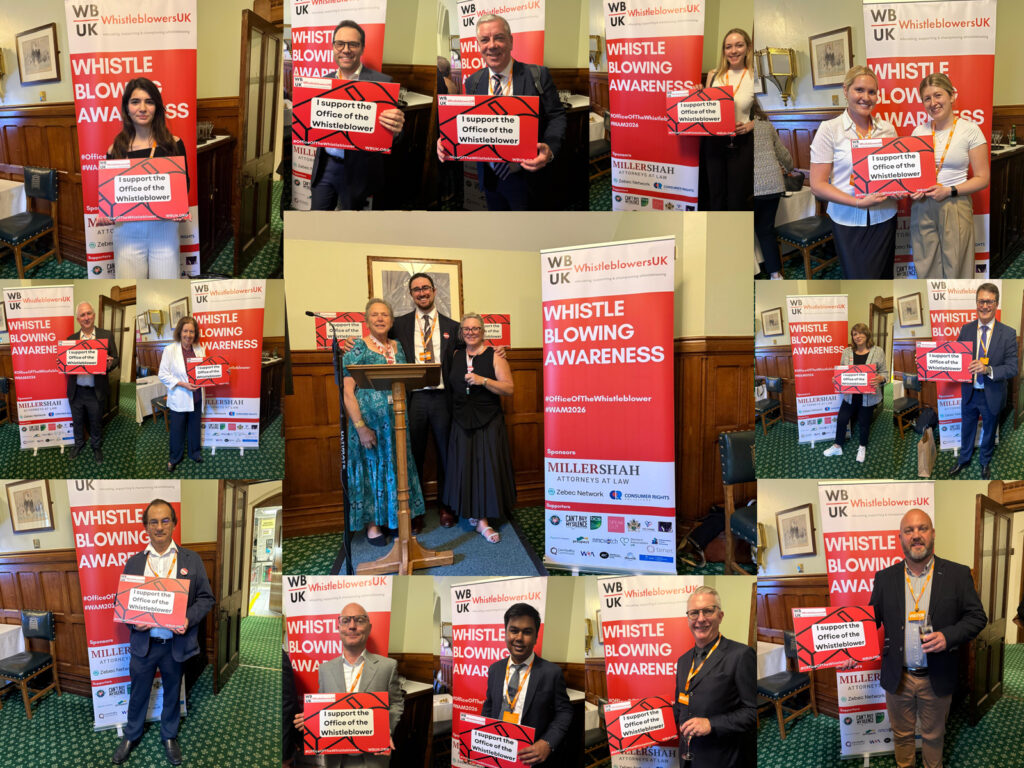
Overwhelming support for an Office of the Whistleblower

